
How do you solve a prospect’s problem and turn it into a successful conversion? If you’re experiencing low conversion rates on high-traffic landing pages, don’t worry – they can help. On today’s Whiteboard Friday, Rand shares a process for turning landing page objections into higher conversion rates.
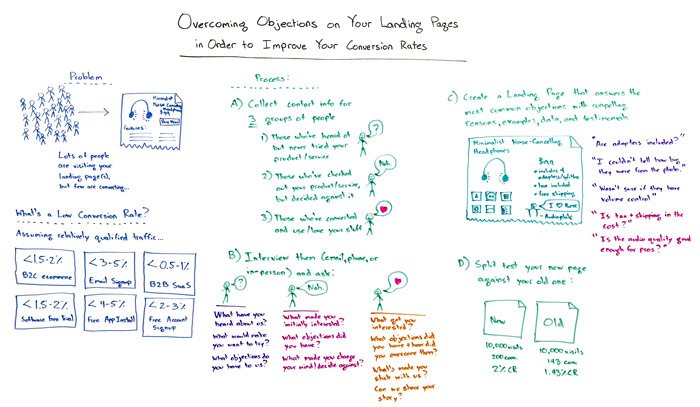
Click on the whiteboard image above to open the high-resolution version in a new tab!
1. Video transcription
Hello Moz fans, welcome to another installment of Whiteboard Friday. This week we’ll talk about how to overcome objections on your landing page to increase conversions. So I stole part of the process from Conversion Rate Experts, a UK consulting firm that Moz had used several times to help us with our campaigns. Karl Blanks and Ben Jesson have been excellent in this regard.
Lo and behold, they’re not the only ones doing it. A lot of people in the conversion rate optimization space use a similar process, but it’s something I talk about and share a lot, so I thought, hey, let’s bring it to Whiteboard Friday.
2. Input questions…
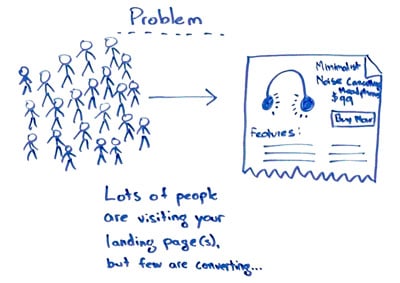
So many times marketers have the problem that a lot of people visit a page, a landing page, where you try to sell a product or get someone to take a conversion action, maybe sign up for an email list or join a community or download an app, try something for free, test a free tool or buy an actual product, such as in this case my minimalist noise canceling headphones.
They are really minimalist due to my poor drawing skills. But when a lot of people visit this page and few convert, you run into conversion rate optimization issues and challenges, and this process can really help you solve it.
First, let’s ask what is a low conversion rate?

The answer is that it really depends on who you are and what you want to achieve. If you’re in B2C e-commerce, like selling headphones, then I think you’re getting relatively qualified traffic. Not only are you driving traffic to this page from sources that may not even know what you’re getting, but the people who actually click here know they’re looking for headphones. From 1.5% to 2%, this figure is quite stable. Below this number, you may have problems. You can most likely improve it.
For email signups, if you’re trying to get people to convert to an email list, B2B is 3% to 5%. Software as a service is slightly lower, ranging from 0.5% to 1%. These tend to be harder to attract people. This number can be higher if you offer B2B products and SaaS products that are free trials or similar products. In fact, software free trials are usually in the range of 1.5% to 2%. Free app installs, such as when people go to an app download page or app homepage or download page, and you see less than 4% or 5%, can be a problem. Free account registration, if you’re referring to people joining a community or connecting a Facebook or Google account to open a free account on a website, this percentage can be in the range of 2% to 3%.
But these are variable. Your mileage may vary. But I would say that if you start with these assumptions and then observe and say “wow, we’re so far below our goal,” yes, let’s try the process.
3. Gather contact information
So what we did at the beginning, and what the conversion rate experts did at the beginning, was to collect contact information for three different groups of people. The first category is people who have heard about your product, your services, and your company, but have never really tried it. Maybe they haven’t even made it to the landing page to convert, but they’re part of your target demographic. They are the audience you want to reach.
The second type of people are people who have tried your product or service but decided to give up. These people may be people who have browsed the cart but abandoned it, so you have their email address. They could be someone who signed up for an email newsletter but canceled their subscription, or someone who signed up for an account but never continued to use it, or someone who signed up for a free trial but canceled before the trial period ended. They may be people who have signed up for a mailing list for a product but never really converted.
The third is the people who have converted, the people who actually use your stuff, like it, tried it, bought it, and so on.
4. You want to interview them.
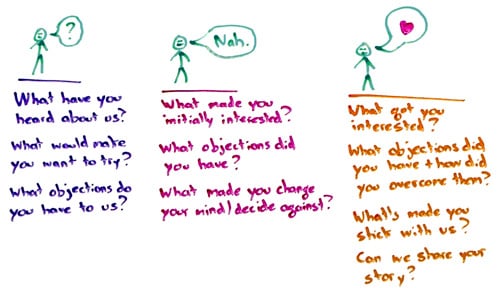
There are three methods you can use, and I recommend combining all of them. You can do it by email, phone, or in person. When we did this work specifically for Moz, or when conversion experts did this for Moz, they used all three methods. They interviewed some people via email, talked to some people over the phone, they attended some of their meetings and events in person, and met with them and did those sit-down interviews.
They then divided the respondents into three groups and asked slightly different questions for each group. For people who have heard of the product but never really tried it, they ask questions like, “What have you heard about us or this product?” What makes you want to try it? What are currently preventing you from trying? ”
For those who give up on buying, they may have tried, or not completely tried but they gave up, and they didn’t end up converting or sticking with it, we can ask, “What interested you initially?” What objections do you have and how do you overcome them? What made you change your mind or decide not to buy the product? “Often, this is caused by a mismatch between expectations and actual delivery.
And then, for those who like it, loyal customers, big fans, you can say, “So, what interests you?” What objections do you have and how do you overcome them? What makes you stick with our products? What makes you like us or this product or this service, this newsletter, this account, this community? If you really like it, can we share your story? “This is useful because we can use them as recommendations later.
5. Create a landing page
And then C, in this process, we’ll actually create a landing page with answers to those questions that are essentially objections, reasons why people don’t buy, don’t convert, or are dissatisfied after buying, and we’re going to turn them into a landing page that provides compelling explanations, compelling reasons, examples, data, and testimonials to help people through the process.
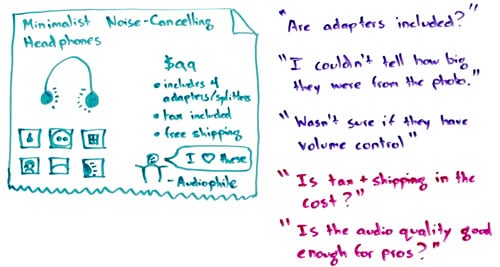
For example, if you hear “Hey, I didn’t buy this because I’m not sure if the right adapter is included for my device” or “I fly a lot, but I don’t know if this headset supports the airplane use I want”, that’s great. We will list all such information on the page such as the types of adapters, which airlines they are compatible with, etc. These are displayed on the page.
If they say, “Hey, I can’t actually tell how big the headphones are.” I know you have sizes there, but I can’t tell how big they are from the photos, “Well, let’s add some representative sample size photos of things that people are very familiar with, maybe CDs, maybe iPhones, and people will say, “Oh yes, I know the size of CDs.” I know the size of the iPhone. I can compare it to headphones. So now here’s one of those pictures. Great, we answered the objection.
“I’m not sure if they have volume control.” That’s great. Let’s put it in the photo.
“Are taxes and shipping included in the price? I don’t want to get stuck in an uncertain cart situation. Great. We will enter “tax included” in it. Free shipping. ”
“Is the audio quality good enough for audiophiles and professionals because I really …… “Well, it’s great.” Let’s find a well-known audiophile and add their rating to the page.
We basically break down the objections we hear the most here one by one and then translate them into content on the page. These can be data, rationale, examples, testimonials. As long as it helps people through the buying process, they will do.
6. Split test
Of course, for each type of conversion rate optimization test and landing page optimization, we all want to try a few variations. So, we’ll split test new and old pages, and if we find higher conversion rates, we know we’re successful.
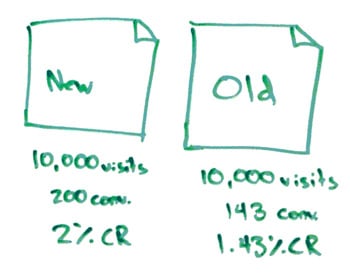
If we don’t, we can start over and expand our audience as much as possible, try and understand why we haven’t been able to overcome these objections, maybe show some of them this new page and see what other objections they have, things like that.
This process is very effective. It helps you spot problems you may not even know existed. In my experience, when companies try to do this, whether it’s for a product or service, for a landing page, for a new account, for an application, whatever, they tend to find the same small subset of answers from these groups over and over again. Just answering those four or five questions correctly and answering them on the landing page can significantly increase conversions.
Alright, folks. We look forward to your suggestions, ideas, and feedback, and we’ll see you next week for another Whiteboard Friday. Take care.