

Is your brand visible to potential customers? If you’re a local business but haven’t decided on local Google SEO, you’re missing out on an opportunity to let customers see your brand when they search on desktop or mobile.
But local Google SEO is not a mystery. It is a coordinated series of steps. We can help you tailor these local Google SEO efforts to your business model. Simply find your business type in the diagram below and follow the steps specific to your needs.
Find out if your customers can find you.
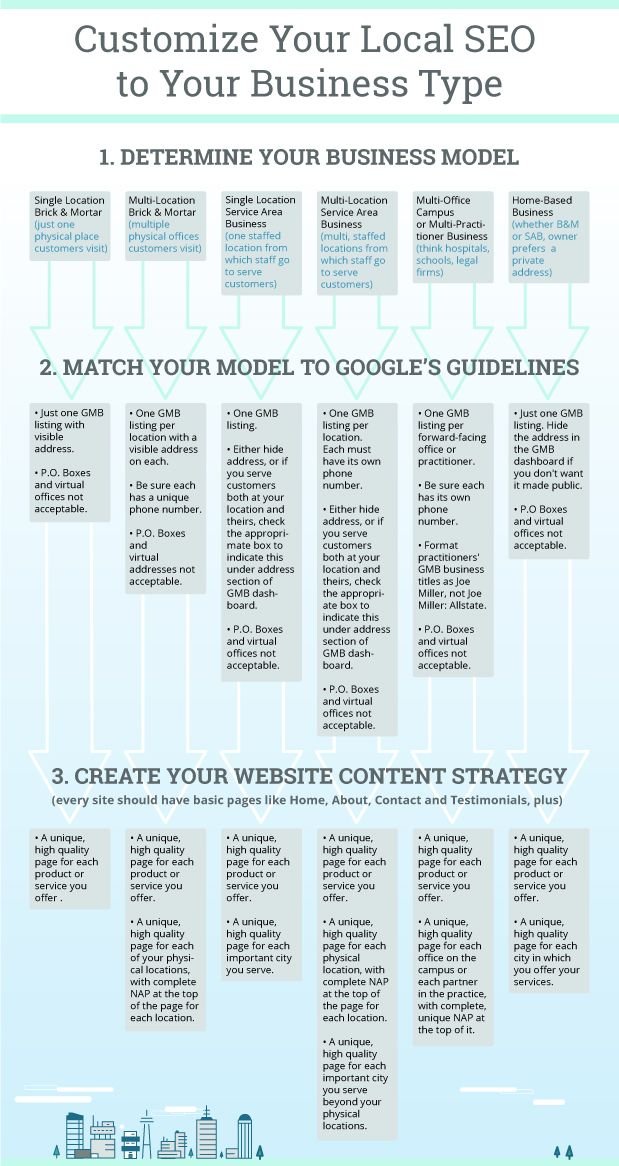
1. Local Google SEO for all business types
But wait! You’re not done yet. There are some local Google SEO steps that work for various types of businesses. Use the checklist below to make sure you tick all the boxes to show up in the SERPs. To jump to a section, use the following link:
- Website technical standards
- Get the right local content
- cite
- Duplicate list cleanup
- Win reviews
- Social media for local businesses
- In the real world
2. Website technical standards
Everything that works with traditional Google SEO also works with local Google SEO.
Regardless of the business model, every local enterprise website needs to be indexable, error-free, compatible with multiple devices, well-structured, and properly optimized. See the full list of technologies.
In addition to the above, local website optimization requires you:
There is a “Contact Us” page with the full name, address, and phone number of each employee’s location.
If you have 10 or fewer locations, the full name, address, and phone number for each location should be in the site-wide footer element.
Use Schema to tag your location data. See Add Schema Location Tagging to Your Website and Local Business Schema Q&A with David Deering for basic and advanced knowledge.
Your phone number is clearly visible on your website and clickable on mobile devices.
Your name, address, and phone number (NAP) are always consistent on your website. Be careful not to let any business name differ or confuse NAP elements for multi-location companies or multi-employee businesses.
All location pages are linked to via the advanced navigation menu.
If you want to keep your street address private, don’t post it on your website, but make sure the phone number you provide is answered during the established business hours.
3. Get the right local content
Content is an essential part of any Google SEO effort, so make sure you don’t get bogged down by thin or duplicate content. Here is a list of common content mistakes, followed by a list of ways to improve your content’s local Google SEO impact.
Content errors to avoid
- Don’t scrape content from other websites, even those of manufacturers or authorities, unless you post attribution citations in your own unique content.
- If you offer the same service or product in multiple cities, think carefully about whether you want to create a unique page for each possible city/keyword combination. Implement this plan only if you know you have enough time, money, and talent resources to create truly high-quality pages for each combination. Avoid publishing thin or useless pages. If you know you don’t have the resources, it’s better to just create a strong page for each city and each service rather than creating a lot of thin or duplicate city/keyword combination pages. See the full resource on developing city landing pages.
- Before deciding on a multi-website approach, think carefully, even if your company offers multiple services or has multiple offices. Many experts agree that building a strong website to promote your brand and all of its services and affiliates is almost always better than allocating time, money, and talent across multiple websites. For more information, see this community discussion.
A way to create unique, user-friendly, and easily searchable content
Use testimonials from customers in the cities you serve to make your city landing page unique.
For related product and service pages, unique testimonials from customers who have used a specific product or service.
After building a basic static web page, create a live blog to continue developing your content library. Freshness can help you rank for a growing number of terms related to your business.
Videos and images are also page content. Label them in the actual text with appropriate labels and consider writing out the transcription.
Offer special offers, schedules, or calendars for specific cities, services, or products to differentiate your business from different locations. For example, offering a schedule of yoga classes at different branches or offering special offers on tree pruning that rotate between different service cities, ensuring that the content on different pages is unique and interesting.
Include resumes of different employees in different locations to introduce customers to the people who serve them.
Sponsor events, teams, or organizations in different cities and write about these sponsorships.
Host or participate in events in different cities as an opportunity to get unique content.
Interview experts inside or outside the company to create city- or product-specific content.
Provide tips that work with specific geographic or demographic audiences.
cite
A citation is a full or partial reference to your name, address, phone number, or website (NAP+W) anywhere on the web. Learn more.
Citation basics
Establish a unique set of citations for each physical office and make sure that the name, address, phone number, and website URL on each citation you create are absolutely correct.
It is normal for abbreviations to vary between platforms (street vs. st. or # with suite). Learn about acceptable abbreviations.
Establish references only for actual physical locations. PO boxes and virtual offices are not acceptable. Understand how local business data flows through the local search ecosystem, as problems on one platform can lead to the same problems elsewhere.
For businesses with multiple locations or practices, link to the site on all citations to the correct corresponding landing page on the site. For example, point your Chicago citation to the Chicago landing page on the website and Joe Miller’s citation to the Joe Miller page on the law firm’s website.
Most local businesses want to be listed on the same major set of local business data platforms in the first place, but in addition to that, establish citations on other platforms specific to your industry or region, such as chambers of commerce, contractor associations, or local newspapers.
If you don’t want your address to be public anywhere, as is the case with many service areas or home-based businesses, you can still create citations, but only on platforms that support hidden addresses.
Watch out for duplicate references – see the duplicate section below.
Automatic or manual reference build: your choice
Build manual references
You have the option to manually build all citations and track their presence, status, and progress in a spreadsheet. The main advantage of this method is that you have more direct control over your listings; The main drawback is that it takes a lot of time to create and manage manually, including the time it takes to update all citations when a business changes its name or moves. If you want to try manual management, these resources will help you understand the top citations you want to build:
- Where to get the quote
- Best citation sources for US cities
- Best local citations by category
- Top 100 International Citation Websites
- Find where your customers are
Automatic citation building
Instead of doing it yourself, you can choose to pay for manual or automatic citation building. The main benefit of this approach is the time-saving and convenient update of multiple citations simultaneously if the business relocates or rebrands; The main drawback is that not all services are of the same quality, and some may cause problems rather than solve them.
With most citation services, you’ll have slightly less direct control over your local merchant listings, but this is usually not a big deal if the product is good. The most important thing is to make sure that any service you are considering is building important citations, not selling useless things, and that there are no known issues about how the service is sold or managed.
If you’re considering purchasing a citation building service, read this comparison guide.
Even if you do pay someone to build citations for you, in some cases you may want to enhance them by manually building some citations on specific niche websites that aren’t available in the proxy package.
4. Duplicate list cleanup
Duplicate content can weaken your listing, so detecting and addressing duplicate content is key. Use these tools and tricks to clear these duplicates:
Basic duplicate listing detection on various platforms is easier by using free tools like Moz Check Listing.
Advanced Google duplicate detection requires special effort. The combination of paid tools + how to write query strings (described here) should help you find as many Google duplicates as possible.
There are many ways you can solve Google-based duplication problems, but Map Maker may be the best option for you. Learn more.
5. Win reviews
Given its powerful role as a ranking and conversion factor, reviews are essential for every local business. Follow these steps to get a review:
Make sure your business is properly listed on major review platforms, including major platforms like Google My Business, Yelp, and Facebook. Make sure you are not ignoring industry or region-specific review sites and are properly listed on those sites.
It is believed that Google reviews have the greatest impact on Google local rankings. Generating shareable Google review links can be challenging, but these tips will teach you how to do it.
Before you start soliciting reviews on any platform, make sure to understand its guidelines. Here you can find links to the main platform guidelines. Be sure to keep an eye on Google and Yelp’s guidelines, they’re pretty special!
Make sure you’ve considered all possible ways to get customer reviews. These tips can help.
Do not set up review stations/kiosks at your business premises to solicit reviews. Always let customers leave reviews under their accounts using their own devices.
Don’t confuse reviews with testimonials. Treat reviews as content on third-party websites and testimonials as content you post on your own website. Live testimonials can be posted on your site on behalf of customers, but Google representatives say they don’t want these testimonials to be marked as review schema. Alternatively, you can add a review widget to your website to let customers leave their own reviews directly.
Don’t request too many comments at once at any time. A sudden influx of comments can cause some platforms to filter reviews. A slow, steady trickle is better over time than a sudden surge.
Understand that review acquisition is an ongoing process that you will be involved in throughout the life of your online business. This is not a project that is set and forgotten.
You know, almost every business will receive at least some negative reviews during its development. The best way to prevent negative reviews is to consistently commit to providing excellent customer service and great work. Be sure to monitor all review sites in case there are red flags of poor quality. Be sure to respond to negative reviews with responsibility and professionalism (these tips will help), and also be sure to respond to positive reviews and take the time to publicly thank your loyal customers.
6. Social media for local businesses
Avoid wasting energy and money by identifying the right social platforms for your business customers. Maximize your return on investment:
Consider the most popular social media sites.
Keep in mind that Google Plus has undergone a major overhaul and is currently promoted as a purely social platform rather than a local one.
Try these tips to determine which social platforms are already popular with your customer base.
Designate one or more employees to be responsible for monitoring and participating in the website of your choice on a regular basis. Don’t let personal data stagnate.
As a social media participant, 99% of your job is to help others, not sell to them. Work on finding opportunities to help, whether it’s answering questions, offering resources, or making someone’s day enjoyable.
Know that social media can be a luck-and-miss experience for any business. You will most likely try multiple platforms and strategies before you find the right market for you. Draw inspiration from the success stories of others.
7. In the real world
All online localization efforts are just a reflection of offline realities and goals. Be sure to keep the following in mind to make sure you’re getting it right where it matters most:
No marketing can replace good business practices. Don’t hire employees without a commitment to training them on basic communication, customer service, and product and service specifications. Don’t let any untrained employees represent your business. Given the power of online reviews, the cost of lack of training is too high.
Implement quality control to stay on top of emerging issues. As a business owner, you must understand your products and services, understand customer complaints, and personally visit your premises to supervise how your employees are serving the public. Regular meetings are held to correct problems, strengthen policies, and provide new education.
Learn how to handle conflict while maintaining self-esteem and teach your employees that too. Whether you’re dealing with a customer who doesn’t take action, is crazy, or is disappointed with some of your business, know that you can apologize and make amends, but that doesn’t mean you’re a bad person. Getting along with your customers and doing the right thing for them will actually make you a very calm, skilled person!
Local search is often touted as a complete replacement for all older forms of offline advertising, but this doesn’t work for all businesses. For some industries and some regions, yellow pages, billboards, local radio and local TV advertising remain viable and profitable forms of advertising.
Remember that everything you do, online or offline, has only one goal: to make your brand the first thing that comes to mind when neighbors need a product or service from you. Don’t limit yourself to basic tasks like website development, citation building, getting reviews, or participating in online social settings. Local brand awareness can also be established by personally participating in community events and organizations. Get out there and meet your neighbors by attending conferences and workshops, contributing to celebrations, sponsoring teams, and being featured in local newspaper headlines through engagement with the community.
8. summary
There are many theories about “effective frequency” about how many times a person needs to be exposed to an ad to respond to it. Some say that the optimal frequency is seven, but not everyone agrees.
You can rest assured that all of the above steps represent your efforts to get your brand to potential customers, and the golden opportunity for local businesses is that their competition is limited by a specific geographical location.
You don’t have to compete with the whole world, but be a stable, reliable resource for your neighbors. Being in the right place at the right time, coupled with excellent service, has a great chance of success for your local business.